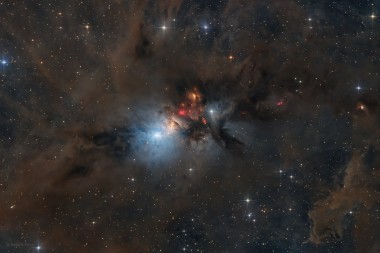
NGC 1333 is seen in visible light as a reflection nebula, dominated by bluish hues characteristic of starlight reflected by interstellar dust. A mere 1,000 light-years distant toward the heroic constellation Perseus, it lies at the edge of a large, star-forming molecular cloud. This telescopic close-up spans over two full moons...
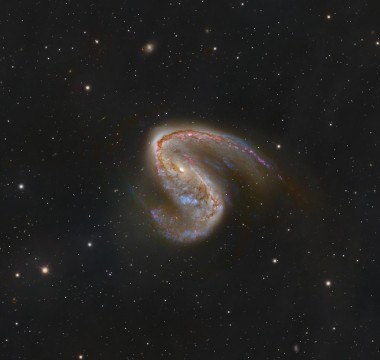
Distorted galaxy NGC 2442 can be found in the southern constellation of the flying fish, (Piscis) Volans. Located about 50 million light-years away, the galaxy’s two spiral arms extending from a pronounced central bar give it a hook-shaped appearance in this deep and colorful image, with foreground stars scattered across the...
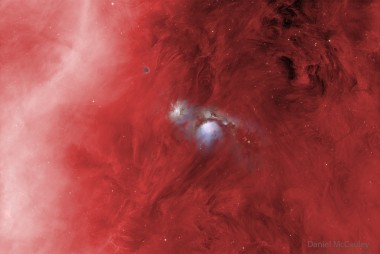
In the vast Orion Molecular Cloud complex, several bright blue nebulas are particularly apparent. Pictured here in the center are two of the most prominent reflection nebulas - dust clouds lit by the reflecting light of bright embedded stars. The more famous nebula is M78, in the image center, cataloged over 200 years ago. To...
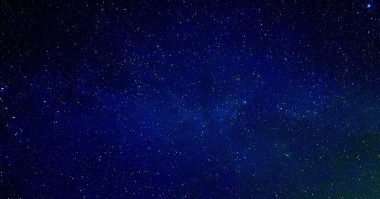
I forgot what settings I used but I used pro-photo mode and enhanced some settings such as brightness and contrast. I did not use any AI. This was before the big AI boom occurred. I just was lucky enough to get clear skies without any light pollution.
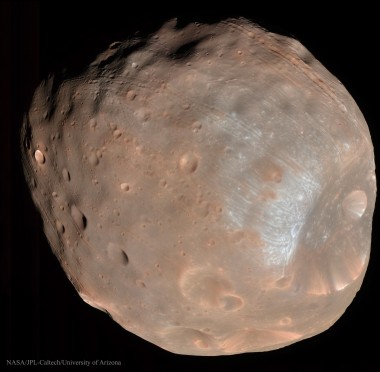
This moon is doomed. Mars, the red planet named for the Roman god of war, has two tiny moons, Phobos and Deimos, whose names are derived from the Greek for Fear and Panic. These Martian moons may well be captured asteroids originating in the main asteroid belt between Mars and Jupiter or perhaps from even more distant reaches of...
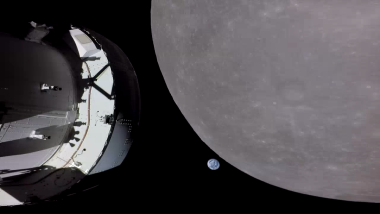
Eight billion people are about to disappear in this snapshot from space taken on 2022 November 21. On the sixth day of the Artemis I mission, their home world is setting behind the Moon’s bright edge as viewed by an external camera on the outbound Orion spacecraft. Orion was headed for a powered flyby that took it to within...
Very faint planetary nebula Abell 7 is about 1,800 light-years distant. It lies just south of Orion in planet Earth’s skies toward the constellation Lepus, The Hare. Posing with scattered Milky Way stars, its generally simple spherical shape about 8 light-years in diameter is revealed in this deep telescopic image. The...
Maybe this lives in showerthoughts, but Chile has a lot of large telescopes and you often hear its because they’re on mountains above clouds. The border with Argentina goes through the middle of the mountains so it seems like it should be a good spot for telescopes too....
Cycle 25 solar maximum made 2025 a great year for aurora borealis (or aurora australis) on planet Earth. And the high level of solar activity should extend into 2026. So, while you’re celebrating the arrival of the new year, check out this spectacular auroral display that erupted in starry night skies over Kirkjufell, Iceland....
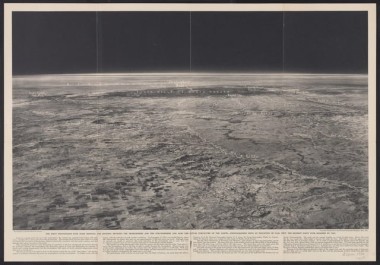
On Dec. 30, 1930, the first-ever photo of the Earth’s curvature was taken by Lieutenant Colonel Albert William Stevens, who was an officer in the U.S. Army Air Corps and an aerial photographer....
So, if an academic paper is published in an open journal by an average citizen with an obsession for learning from online sources. So, there are no credentials but a decent work history. A prestigious college downloads the paper. What are the possible reasons?
As we're approaching the summer solstice, I'm going to harden my heart to the fact that it won't be getting nice and dark until, like, ten where I'm at. What are you guys going to be looking for tonight? If you're not going out, do you have any recommendations?...
So I’ve been posting space related stuff here for a while over !space to distribute content more, within the last few weeks though it was closed and now directs posting to this other mander space comm !space which is titled “Space & Astronomy”...
Hey everybody, I know it’s a little late, but I wasn’t really sure how the weather was going to be until a little while ago. I’d like to invite you all to join me in looking at the sky tonight. What’s on the menu:...